
ERPC Boosts Solana Unlimited Endpoints Concurrency by 30–50% — More Threads, Less Transaction Congestion, Same Price
ERPC Boosts Solana Unlimited Endpoints Concurrency by 30–50% — More Threads, Less Transaction Congestion, Same Price
ELSOUL LABO B.V. (Headquarters: Amsterdam, Netherlands; CEO: Fumitake Kawasaki) and Validators DAO, the operators of ERPC, are pleased to announce a performance boost across all Solana Unlimited Endpoints plans, delivering a 30–50% improvement in concurrency.
By increasing the number of processing threads, the volume of queries that can be handled simultaneously has grown substantially, making transaction congestion significantly less likely. This upgrade is delivered as a product renewal at the same price.
Performance Boost Overview
Thread Scaling for Higher Concurrency
The core of this update is an increase in processing threads. By expanding the thread count powering the Unlimited Endpoints infrastructure, the number of requests that can be processed simultaneously has improved by 30–50%.
This improvement propagates across the entire RPC endpoint processing pipeline.
Request acceptance stage — The concurrent connection acceptance ceiling has been raised, substantially reducing the probability of requests queuing in the wait buffer during peak loads. Previously, when large volumes of requests arrived in short bursts, congestion at the acceptance stage caused response delays and connection timeouts — this bottleneck has been alleviated.
RPC method execution stage — With more parallel processing threads available, the time each individual request spends waiting for thread assignment has been shortened. RPC methods such as getTransaction and sendTransaction are now more likely to be dispatched to a thread immediately rather than queuing.
Transaction submission stage — The issue of RPC-side processing falling behind during submission surges, causing response delays, has been mitigated. On Solana, the timing of transaction submission is a decisive factor in success or failure — RPC-side queuing directly results in delayed landing, MEV opportunity loss, and failed trades. With the thread increase, transactions are far less likely to stall at the RPC layer even under peak load conditions.
What Are Unlimited Endpoints?
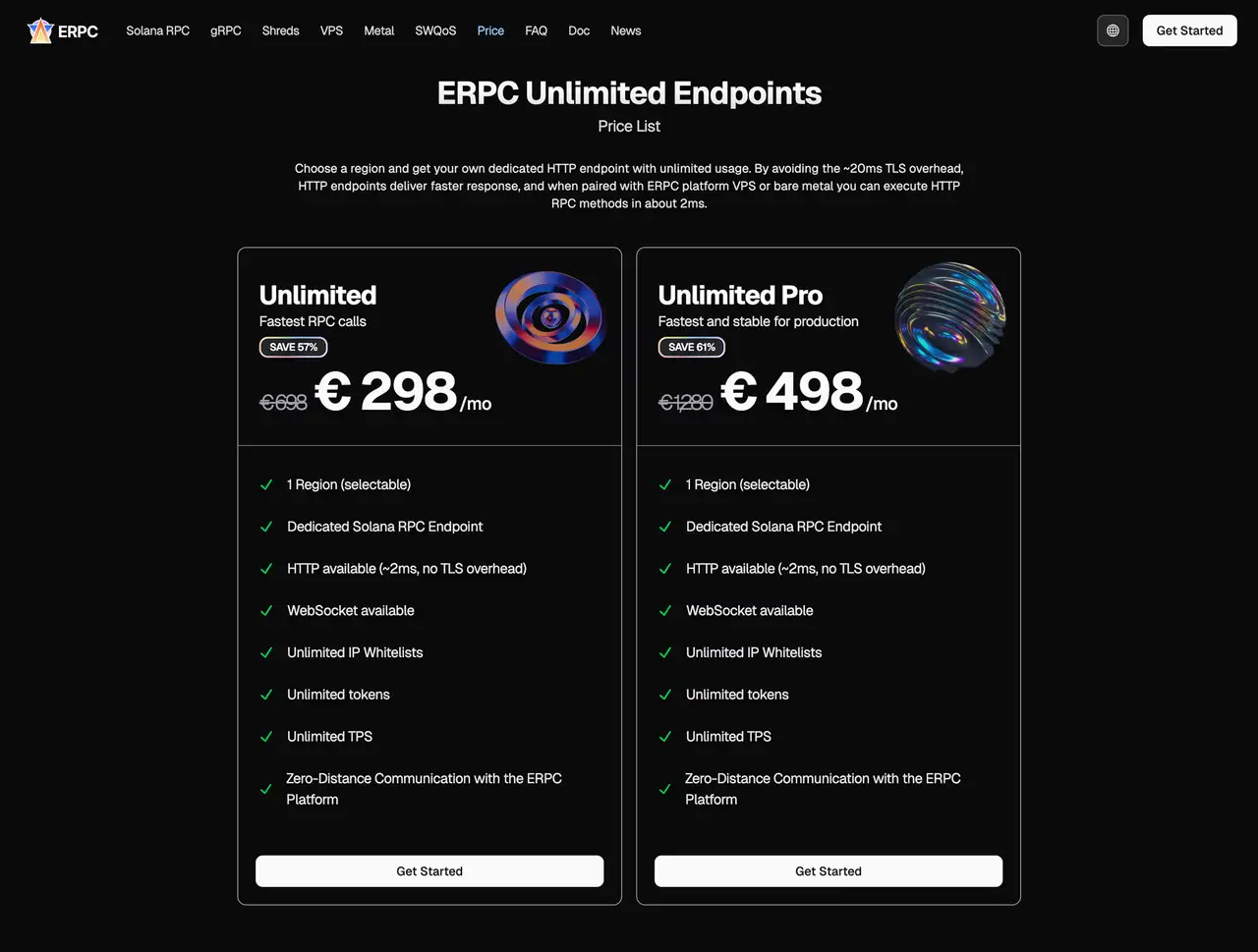
Unlimited Endpoints let you choose a region and get your own dedicated HTTP endpoint with unlimited usage. Standard HTTPS communication incurs approximately 20ms of overhead from the TLS handshake — Unlimited Endpoints eliminate this entirely by providing HTTP communication. When paired with ERPC platform VPS or bare metal, RPC method execution in approximately 2ms is achievable.
- Unlimited (€298/mo) — Dedicated endpoint for the fastest RPC calls
- Unlimited Pro (€498/mo) — Fastest and stable for production. Built for professionals who demand higher concurrency and reliability
Both plans include: 1 region (selectable), dedicated Solana RPC Endpoint, HTTP communication (no TLS overhead, ~2ms), WebSocket support, unlimited IP whitelists, unlimited tokens, unlimited TPS, and zero-distance communication with the ERPC platform.
Choosing Between ERPC Plans and Unlimited Endpoints
ERPC Plans — Global Edge HTTPS Endpoints
ERPC's standard plans use HTTPS and route traffic through globally distributed edge points, ensuring the shortest path to ERPC's Solana endpoints from anywhere in the world. Designed primarily as dApp endpoints, they provide secure HTTPS communication as standard — making them ideal for frontend applications, standard apps, and UI-based access.
For example, when using custom endpoints in DeFi protocols like Axiom or Orca, ERPC plans offer a convenient solution. Custom endpoints are commonly used as a bypass to Solana RPC, providing a dedicated route that avoids congestion on shared public endpoints.
A clear illustration of this advantage is the MadLads NFT mint. At the time, MadLads saw intense competition — access was so heavy that the service went down repeatedly. Yet the majority of successful minters were custom endpoint users. The dApp's default RPC endpoint was flooded with global traffic and lacked sufficient bandwidth, while custom endpoint users had their own dedicated route, bypassing the congestion entirely.
Unlimited Endpoints — Fixed Region, Competing at the Millisecond Level
The strength of Unlimited Endpoints lies in fixing a region to achieve faster speeds and handle more queries.
Given Solana's validator stake distribution, Frankfurt and Amsterdam are structurally the most popular regions. For use cases like high-frequency trading, participants concentrate their traffic in these regions, competing at the 1ms level. In these scenarios, backend-only applications that operate at maximum speed are preferred over UI-based access, and Unlimited Endpoints are the optimal choice for this purpose.
HTTP communication with TLS overhead eliminated, dedicated endpoints with no resource contention from other users, and unlimited TPS — all of this is available at a cost-effective price point, without the need to provision an entire dedicated RPC.
SWQoS Bonus Connection in Frankfurt
In the high-demand Frankfurt region, Unlimited Endpoints include a bonus SWQoS node connection powered by the high-performance Epics DAO Validator.
The Epics DAO Validator currently holds over 200,000 SOL in active stake and has achieved a TOP 20 ranking in the Shinobi Performance Pool. The SWQoS endpoint backed by this validator is connected as a bonus to Unlimited Endpoints, enabling transaction submission through Stake-weighted Quality of Service priority lanes.
For those who want to leverage both HTTP-based high-speed submission workflows (TLS overhead eliminated, ~2ms RPC execution) and SWQoS priority-lane transaction submission, this is the ideal choice — both capabilities are available through a single endpoint.
Why We Build the Fastest Platform Ourselves
Trust and Brand Alone Don't Deliver the Fastest
The server industry has a structural reality: the quality of resources provided varies based on how much the customer knows. Datacenter operators have a constant incentive to save on power and network bandwidth — the less they spend, the higher their margins. A customer's improved performance does not translate to increased revenue for the datacenter.
We have firsthand experience: when we requested "the fastest" configuration, the quote we received included a 10-year-old network card at a premium price. If the customer doesn't notice, that markup becomes pure profit — this is the incentive structure of the server industry. Trust and brand alone cannot deliver the fastest environment.
The Structural Problem ERPC Solves
Traditionally, building a high-speed application environment on Solana required deep expertise: investigating which datacenter an RPC vendor's servers are in, procuring bare metal in the same network, auditing and disabling performance-save settings, and tuning at the OS level. In practice, many users lack this knowledge and procurement capability, leaving performance on the table.
ERPC integrates the Solana RPC platform with the bare metal servers, VPS, Shreds, and Unlimited Endpoints that users deploy — all within a single platform. Simply deploying within the ERPC platform gives you the fastest communication conditions, pre-optimized configurations, and Solana-specific tuning from the start. No deep datacenter expertise required — this is ERPC's design philosophy and the reason we continue to build our own platform.
QUIC Sender Service in Development
ERPC is currently developing a QUIC Sender service. QUIC is a next-generation transport protocol that will enable even faster transaction submission on the Solana network.
If you're interested, please join the early access waitlist by creating a support ticket in the Validators DAO official Discord.
5 Consecutive Years of WBSO Approval — R&D Driving Performance
ELSOUL LABO has received consecutive WBSO approvals from the Dutch government since 2022, spanning five years. Ongoing research into ultra-low-latency Solana RPC infrastructure and automated validator placement and operations orchestration continues to feed directly into platform performance improvements.
This Unlimited Endpoints performance boost is another instance of accumulated R&D knowledge being deployed into production. The compounding nature of R&D means the rate of improvement accelerates over time.
The Next-Generation Option — AS200261 Solana-Dedicated Datacenter
ELSOUL LABO has been assigned its own ASN (AS200261) by RIPE NCC and is building a top-tier Solana-dedicated datacenter. Designed to surpass existing premium datacenters as the highest-quality infrastructure available, it is scheduled to begin operations from this month to next.
Hardware is unified around the latest generation: AMD EPYC 5th Gen, AMD Threadripper PRO 5th Gen (9975WX and similar), and NVMe Gen 5 — complemented by optimal network route design through ELSOUL LABO's own ASN. Performance and ASN concentration score advantages simultaneously — conditions that were previously considered mutually exclusive.
The initial lot is sold out, but subsequent inventory will be offered in waitlist order.
Contact
For inquiries about Unlimited Endpoints, please create a support ticket in the Validators DAO official Discord.
Validators DAO Official Discord: https://discord.gg/C7ZQSrCkYR
For official ERPC information and plan details, please visit:
ERPC Official Website: https://erpc.global/en
Thank you for your continued support of ERPC.
News