
Validators DAO Open-Sources Sample Code for Real-Time pump.fun Token Mint Detection With Solana Geyser gRPC Streams
Validators DAO Open-Sources Sample Code for Real-Time pump.fun Token Mint Detection With Solana Geyser gRPC Streams
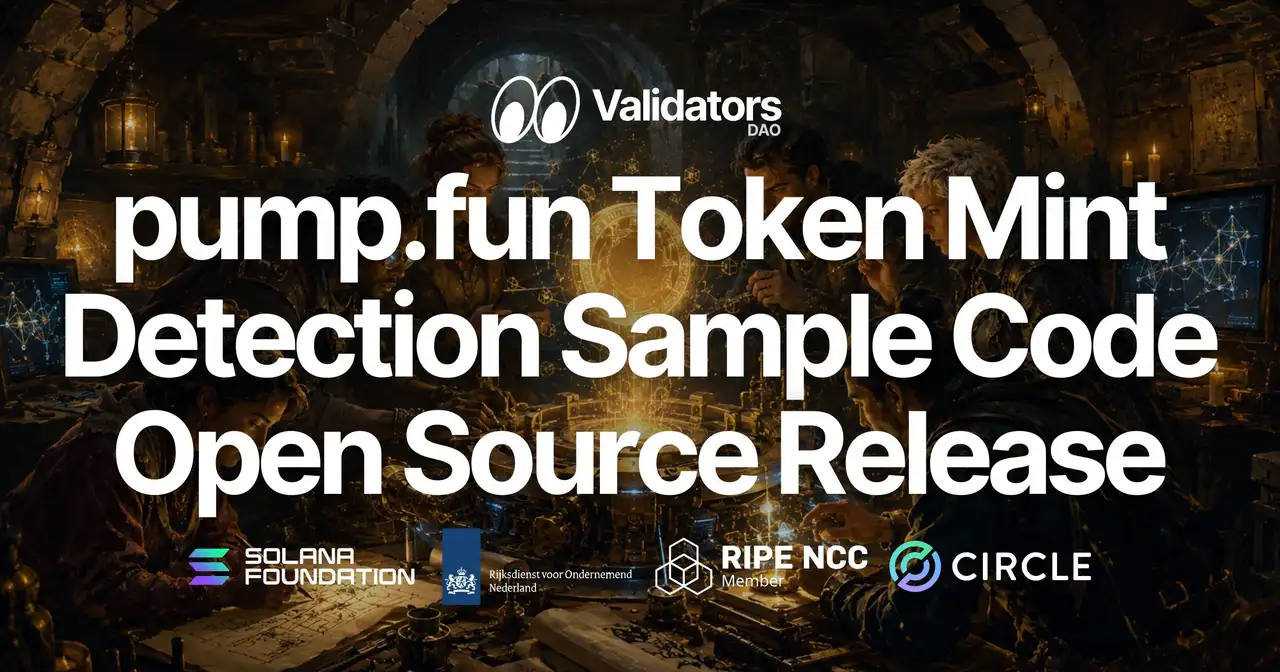
ELSOUL LABO B.V. (Headquarters: Amsterdam, the Netherlands; CEO: Fumitake Kawasaki) and Validators DAO have open-sourced sample code for detecting pump.fun token mints in real time using Solana Geyser gRPC streams.
This sample code is an example implementation for receiving Solana on-chain events as a stream and detecting events that match specific conditions in real time. Using pump.fun token mints as the subject, developers can examine how data flowing through a Solana Geyser gRPC stream can be processed to detect when matching events occur.
Real-Time Solana Data Processing Through pump.fun Token Mint Detection
A pump.fun token mint is a clear example of an on-chain event on Solana that is well suited for real-time data processing. By detecting the moment a new token mint occurs and passing that information to downstream processing, developers can examine the basic event-driven structure required by Solana applications.
In real-time Solana applications, quickly understanding what happened on-chain is important. Receiving a new event, identifying the target, extracting the necessary information, and passing it to the next process form a common foundation across notifications, logging, monitoring, analytics, indexing, backend processing, and many other Solana application workflows.
The sample code released here makes that flow concrete through pump.fun token mint detection. Developers can read the code, test the behavior, and extend the detection conditions or downstream processing according to their own use cases.
Receiving On-Chain Events Through Solana Geyser gRPC Streams
There are multiple ways to handle Solana on-chain events, including HTTP RPC, WebSocket, Geyser gRPC, and Shredstream. Among these, Geyser gRPC streams are well suited for continuously receiving data such as accounts, slots, blocks, and transactions, and processing that data in real time on the application side.
HTTP RPC is a mechanism for requesting and retrieving the information needed at a given point in time. It is suitable for historical checks, state retrieval, and individual transaction confirmation. However, when continuously tracking events that occur on-chain, repeatedly polling large ranges after the event has occurred can increase network traffic, processing load, and timing overhead.
WebSocket is also a useful mechanism widely used in Solana development. Geyser gRPC streams, however, make it possible to receive events as a continuous flow of data and process them immediately on the application side. For workloads such as pump.fun token mint detection, where specific on-chain events need to be captured quickly, a streaming architecture makes it easier to build processing around the data at the moment it occurs.
Efficient Stream Communication With HTTP/2 and Protocol Buffers
gRPC is built on HTTP/2 and can use long-lived connections, connection multiplexing, header compression, and binary representation through Protocol Buffers. For workloads that continuously receive large amounts of data and process the required events on the application side, these characteristics directly support communication efficiency and cleaner implementation design.
With polling or repeated request/response RPC flows, each data retrieval tends to require issuing a request, waiting for a response, and then applying another round of event matching on the application side. WebSocket can use persistent connections, but when a system is built mainly around JSON-based Solana subscriptions or broad notifications, interpretation, filtering, and downstream processing often shift heavily to the application layer.
Geyser gRPC streams make it easier to receive structured Solana data continuously on top of HTTP/2 and Protocol Buffers. In real-time on-chain event detection, applications can receive the required data as a stream and process only the events that match the target conditions. This makes it easier to reduce unnecessary queries and duplicate retrieval, while designing real-time data processing with lower communication volume and processing overhead.
The pump.fun token mint detection sample code is an entry point for examining this Geyser gRPC stream-based implementation. Developers can review the code structure for receiving on-chain events, checking the required conditions, and connecting detected events to downstream processing.
Real-Time Detection Matters on Solana, Where 432,000 Slots Progress per Epoch
On Solana, 432,000 slots progress rapidly in each epoch. The amount of data handled is also large, and in our Solana RPC infrastructure operations, the data volume handled per epoch can reach around 500 GB depending on the scope and configuration. When on-chain events are reconstructed later by backfilling large ranges, the load on processing time, bandwidth, compute resources, storage, and indexing can become significant.
Real-time detection is an important design approach for reducing that load. By receiving the required events at the moment they occur, recording only the relevant records, and executing only the necessary downstream processes, applications can reduce broad refetching and unnecessary data processing.
A pump.fun token mint is one concrete example. Instead of processing all data heavily after the fact, identifying the target event from the stream at the moment it occurs makes it easier to build application structures that match Solana's high-speed data generation.
What the Sample Code Shows
The sample code released here shows the flow for detecting pump.fun token mints in real time using Solana Geyser gRPC streams.
The main areas developers can examine are the connection to a Geyser gRPC stream, processing of data received from the stream, event matching for pump.fun token mints, and connection to downstream processing after detection. This makes it possible to understand real-time Solana data processing through concrete code rather than abstract explanation.
Developers can use this sample code as a starting point to adjust detection conditions, change output formats, add notification or storage processing, and apply the structure to other on-chain events. Starting with the concrete subject of pump.fun token mint detection makes it easier to understand the basic structure of real-time event processing using Solana Geyser gRPC streams.
Open Source Release
This sample code is released as open source. It provides an example implementation of real-time event detection using Solana Geyser gRPC streams in a form that anyone can inspect, use, and modify.
In a high-speed, high-volume network like Solana, the method of data retrieval itself affects application performance and operating cost. If applications repeatedly search large data ranges every time they need a specific event, the load increases not only for the application but also for RPC, networking, storage, and indexing infrastructure.
By using Geyser gRPC streams to receive required events at the moment they occur and process only the relevant data, applications can reduce unnecessary queries, duplicate retrieval, and excessive bandwidth consumption. This kind of low-cost stream communication can improve not only real-time performance in Solana applications, but also data retrieval cost and communication efficiency.
This sample code is provided so developers can examine that kind of real-time Solana data processing as an implementation. Through pump.fun token mint detection, developers can concretely verify Geyser gRPC streams, HTTP/2, Protocol Buffers, and real-time on-chain event processing.
Feedback
Validators DAO continues research and development around real-time Solana data processing. For the pump.fun token mint detection sample code released here, we welcome feedback on improvements found through actual use, additional detection targets, stream processing extensions, and requests related to notification or storage integrations.
To make this real-time detection implementation using Solana Geyser gRPC streams easier for more developers to use, please review the sample code and share your feedback.
Validators DAO Official Discord: https://discord.gg/C7ZQSrCkYR
Disclaimer
This article and sample code are technical materials for research and development related to Solana on-chain event detection, Geyser gRPC streams, and real-time data processing. They do not constitute investment advice, trading strategy recommendations, or solicitation to buy or sell any specific token, asset, or protocol.
Please review and verify the contents carefully before using the sample code, and use it at your own risk.
News