
ERPC's Tokyo and Singapore Bare-Metal Servers Are Sold Out — Solana-Specific Optimal Configuration and a Network Design Close to Major Nodes. While You Wait for Restock, Try Our High-Speed VPS on the Same Network, From Hourly Billing
ERPC's Tokyo and Singapore Bare-Metal Servers Are Sold Out — Solana-Specific Optimal Configuration and a Network Design Close to Major Nodes. While You Wait for Restock, Try Our High-Speed VPS on the Same Network, From Hourly Billing
ELSOUL LABO B.V. (Headquarters: Amsterdam, Netherlands; CEO: Fumitake Kawasaki) and Validators DAO, which operate ERPC, announce that bare-metal servers in the Tokyo (TYO) and Singapore (SGP) regions are now sold out. We sincerely thank all of our users for their continued support of ERPC.
ERPC's bare-metal servers are characterized by a configuration focused on low-latency, high-throughput operation on Solana. With its Solana-specific optimal configuration and its direct connectivity on a network close to major Solana nodes, it has earned the trust of customers who prioritize getting transactions and data to the leader-side processing path sooner (first-arrival). Owing to high regard for its low-latency performance, it has continued to be taken almost as soon as it arrives. At the same time, ERPC's VPS is also deployed on the same Solana-specific data centers and the same proximate network as our bare metal. While it does not guarantee performance identical to dedicated bare metal, it serves as a validation environment while you wait for restock, and as a high-speed option for first checking actual behavior from your own point of origin. Since the VPS can be tried from hourly billing (per hour), you can verify its real-world speed and stability from your own bot or application's point of origin.
ERPC Official Site: https://erpc.global/en
ERPC Dashboard: https://dashboard.erpc.global/en
Tokyo and Singapore Bare Metal Sold Out — Our Thanks, and What Comes Next
Tokyo and Singapore are regions for which we receive especially strong demand from customers working on real-time trading and bot operations on Solana across Asia. That bare-metal servers in both regions have now sold out is owed entirely to the support of the users who use ERPC every day.
For sold-out resources, you can register on the waitlist in the ERPC dashboard. Everyone who joins the waitlist is offered incoming stock first, and when the resource you want is restocked, we reach out to you personally. There is no need to keep reopening the dashboard to check whether stock has appeared. You don't miss the next restock, and you receive guidance on a priority basis.
ERPC Dashboard: https://dashboard.erpc.global/en
The Strengths of Bare Metal — Solana-Specific Optimal Configuration and Proximity to Major Nodes
There are clear reasons ERPC's bare metal is fast. First, a configuration optimized for Solana. The Agave validator requirements indicate a base clock of 2.8GHz or higher as the CPU baseline; ERPC's bare metal adopts high-clock CPUs well above that level and emphasizes a configuration that keeps processing headroom even at peak. In an environment where the CPU stays pinned at high utilization, queuing and jitter become more likely, which — for use cases that prioritize first-arrival — leads to worse tail latency. Dedicated bare metal does not have the jitter or stalls from "noisy neighbors" common to virtualized environments.
Second, proximity to major Solana nodes. ERPC suppresses distance-induced latency at the design stage by placing source nodes, receiving endpoints, and processing nodes inside premium data centers where Solana validators are densely concentrated. In applicable same-network configurations, you can construct a short path that avoids external transit and does not traverse the public internet. This direct connectivity on a proximate network is the foundation that supports bare metal's low latency.
And the operational know-how behind this optimization is consolidated as recipes in SLV, the open-source Solana operations tool. The speed of ERPC's bare metal does not rest on a trick for one special box, but on reproducible operational recipes.
The Same Solana-Proximate Network as Bare Metal, on a VPS — Confirm the Gap Versus Major Clouds by Measurement
ERPC's VPS, too, is chosen by many developers. The VPS is a different delivery form from dedicated bare metal, but it sits on the same Solana-specific data centers and the same proximate network as ERPC's bare metal, tuned with the same operational know-how.
In other words, even while you wait for bare metal to be restocked, you can validate ERPC's infrastructure — running close to Solana — at a smaller unit. Bare metal is the right fit for production workloads that require dedicated resources; meanwhile, as a first option for checking latency from your point of origin, real application behavior, and the difference versus a cloud virtual machine, ERPC's VPS is effective.
The benchmark below places ERPC's VPS side by side with a comparably specced major-cloud virtual machine (both AMD Turin / 4 vCPU, Amsterdam, Ubuntu 24.04), measured under the same conditions. This is a measurement under identical conditions.
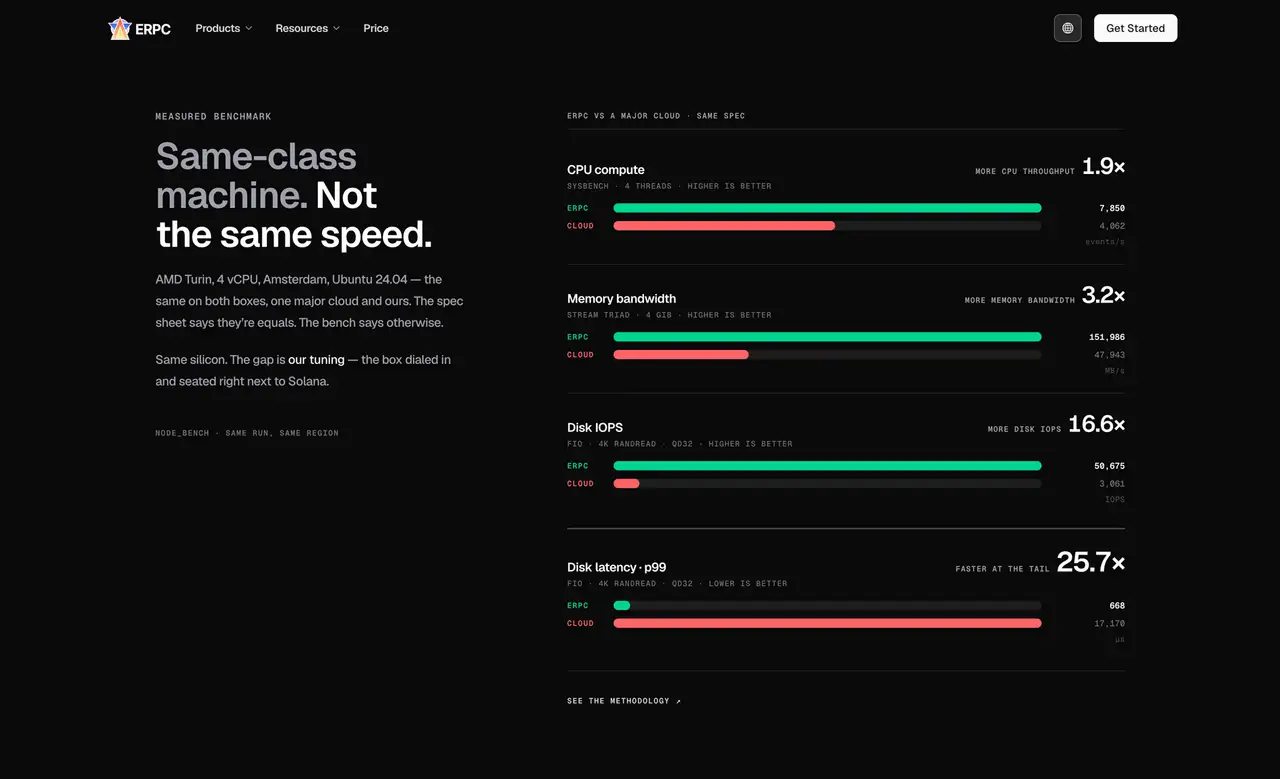
- CPU throughput (sysbench / 4 threads, higher is better): ~1.9×
- Memory bandwidth (STREAM Triad / 4 GiB, higher is better): ~3.2×
- Disk IOPS (FIO / 4K random read, QD32, higher is better): ~16.6×
- Disk p99 latency (FIO / 4K random read, QD32, lower is better): ~25.7× faster at the tail
Even with the same silicon and the same spec-sheet figures, the speed is not the same. That difference comes from ERPC's tuning — building out the host configuration, the virtualization layer, storage, and network placement, and seating the box right next to Solana. On the spec sheet they look evenly matched; measure them, and the story changes.
Note that the multipliers above are one example under this measurement's conditions. The actual difference varies with workload, point of origin, and time of day. That is exactly why ERPC consistently emphasizes demonstrating delivery quality and speed through measurement that anyone can verify the same way, rather than through subjective claims or marketing copy. The surest approach is to compare directly under conditions close to your own workload.
Speed Is Determined by Your Distance to Solana — A Direct Route on the Same Network
In a word: the closer you are, on the network, to the Solana servers involved in your trading, the faster. What ultimately determines speed is not only your code or your machine's specs, but the most overlooked layer — your network distance to Solana. On Solana, the leader that builds blocks switches slot by slot. Because of this, a configuration in which transactions and data reach the leader-side processing path with a shorter RTT tends to be advantageous for use cases that prioritize first-arrival. Distance is one of the main factors that determine latency.
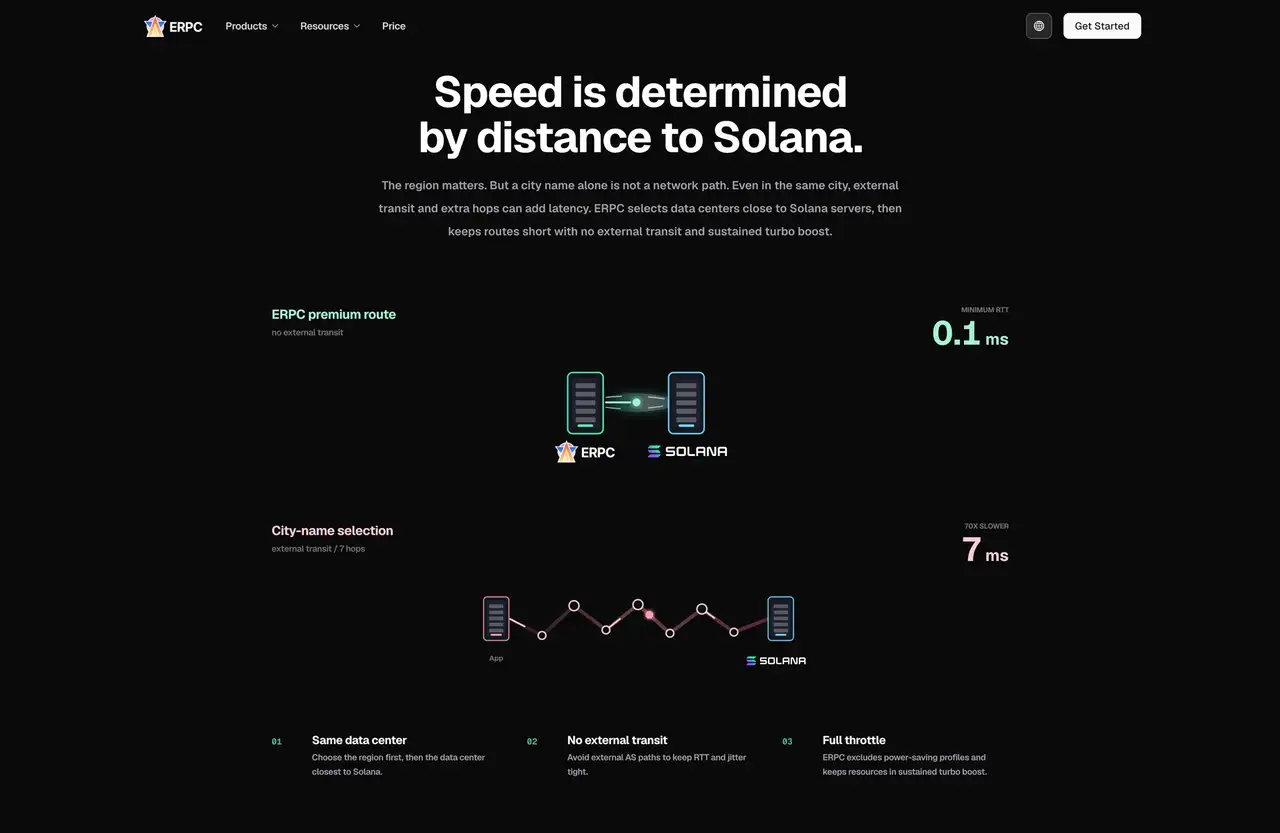
A "city name" is not the network path itself. Even within the same city, if external transit or extra hops (the number of routers a signal passes through) are inserted, latency piles up by that much alone. ERPC chooses data centers close to Solana's servers, keeps routes short without inserting external transit, and operates resources with headroom left so it can draw out performance at the necessary moment. A direct route on the same network can be configured as a very short path, such as a minimum RTT of ~0.1ms, while a roundabout path with external transit can rise to about 7 relay hops, where latency can widen substantially (the contrast in the figure is a set of round figures meant to convey, intuitively, the gap between a near route and a far one).
Whether bare metal or VPS, this foundation — closeness to Solana on the network — is shared. That said, dedicated bare metal and a VPS differ in the nature of CPU exclusivity, I/O isolation, jitter characteristics, and tail latency. That is why, for a final production configuration, dedicated bare metal can be advantageous in some situations. At the same time, while you wait for bare metal to be restocked, you can check speed and behavior on a VPS on the same Solana-proximate network — first, in a form close to your own conditions.
Try It From One Hour, on Hourly Billing
ERPC's VPS can be tried from a single hour on the hourly billing plan. This makes for a low-risk validation loop. You can contract for just one hour, confirm the actual behavior as seen from your own bot or application's point of origin within that time, and decide on moving to a monthly or yearly plan based on the results. The benchmark above, too, can be reproduced and compared within that one-hour trial, under your own conditions.
Even if you switch to a monthly or yearly plan once your configuration and usage come into view, you can proceed with the same dashboard, the same payment flow, and the same management experience. ERPC credit purchases and payment for the various plans can also use Crypto Pay (SOL / USDC / EURC), and the hourly plan is supported as well. You can begin validation straight from the assets in your Solana wallet.
ERPC Dashboard: https://dashboard.erpc.global/en
On Supply and Delivery — A Transparent Note
Let us share the current situation around bare-metal supply honestly. Demand for memory and other components is surging worldwide, and bare-metal procurement is expected to be affected by tight supply. We intend to keep procurement costs down and to hold the current price level for as long as we can. At the same time, depending on future procurement conditions, a price revision may become unavoidable.
Stock tends to be limited across the board right now, and popular resources continue to be taken almost as soon as they arrive. If the resource and region you want are already decided, we recommend securing it while stock is available, or joining the waitlist. Waitlist sign-ups are also factored into our future restocking plans.
And we respond to rising demand not by restricting or degrading service, but by strengthening our procurement capability itself. We will continue to work on strengthening our supply structure.
The Right Resources, in the Right Place
ERPC aims to provide the right resources, in the right amount, in the right place — on the premise that each Solana application needs a different configuration. On ERPC, you can combine Solana RPC, WebSocket, Solana Geyser gRPC, Solana Shredstream, Direct UDP Stream (Raw Shreds), VPS, bare-metal servers, dedicated RPC, SWQoS, a Pyth-compatible Price API, and Jet Analytics & Indexed RPC on a single platform.
The ERPC dashboard supports 16 languages, and from the same screen you can choose plans, select regions, check stock, join the waitlist, add to cart, top up credits, check out, review API keys and endpoints, monitor usage, and create support tickets.
R&D and Continuous Improvement of Solana-Specific Infrastructure
Behind ERPC is the research and development of Solana-specific infrastructure that ELSOUL LABO continues to pursue. ELSOUL LABO has been approved for five consecutive years since 2022 under WBSO, the Netherlands' government R&D support program. It continues R&D on Solana RPC infrastructure, validator operations, real-time data delivery, and AI-agent-assisted operations and development, and those results are reflected across services including ERPC, SLV, SLV AI, and the AS200261 Solana-specific data center.
The speed of ERPC's bare metal and VPS, too, took shape from validator operations in the field. ERPC will continue to provide low-latency infrastructure close to the Solana network, and to demonstrate its quality through measurement that anyone can verify the same way.
Usage and Consultation
For help selecting bare metal or VPS, planning region configurations, joining the waitlist, choosing between hourly / monthly / yearly billing, or designing a migration from an existing setup, we offer individual consultation on the official Validators DAO Discord.
ERPC Dashboard: https://dashboard.erpc.global/en
ERPC Official Site: https://erpc.global/en
Validators DAO Official Discord: https://discord.gg/C7ZQSrCkYR
We sincerely thank all of our users for their continued use of ERPC. We will keep improving our performance and our service.
Links
- ERPC Official Site: https://erpc.global/en
- ERPC Dashboard: https://dashboard.erpc.global/en
- ERPC Pricing: https://erpc.global/en/price/
- SLV Official Site: https://slv.dev/en
- SLV GitHub: https://github.com/validatorsDAO/slv
- Validators DAO Official Discord: https://discord.gg/C7ZQSrCkYR
News