
Solana Begins Testnet Validation of Post-Quantum Signatures (Quantum-Resistant Signatures). Validators DAO Supports Validator Operations Through SLV Updates
Solana Begins Testnet Validation of Post-Quantum Signatures (Quantum-Resistant Signatures). Validators DAO Supports Validator Operations Through SLV Updates
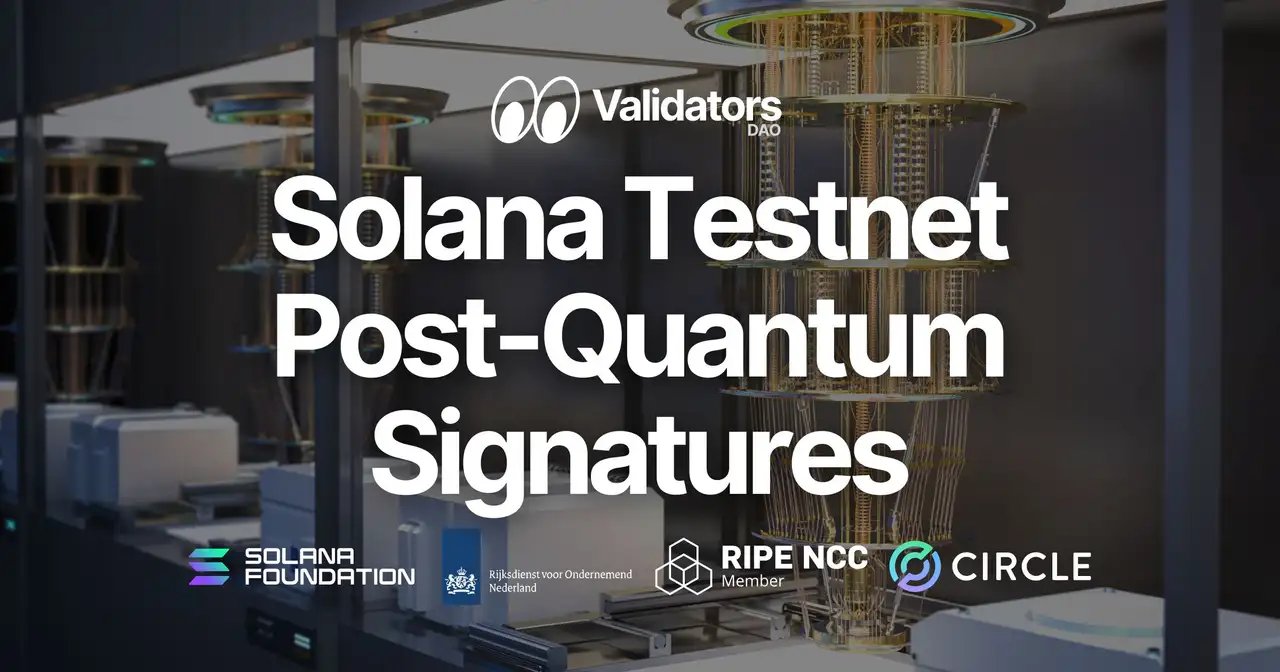
ELSOUL LABO B.V. (Headquarters: Amsterdam, the Netherlands; CEO: Fumitake Kawasaki) and Validators DAO announce that they are closely monitoring Solana’s ongoing testnet validation of post-quantum cryptography (Post-Quantum Cryptography, hereafter “PQC”)–based signature schemes, commonly referred to as quantum-resistant signatures, and are continuing corresponding updates to testnet operations and the open-source platform SLV in response to these developments.
This development indicates that the ecosystem has entered a preparatory phase aimed at maintaining blockchain security over the long term, in anticipation of the practical emergence of quantum computing. Cryptographic migration is no longer merely a research topic; it has become an operational challenge that requires real-world validation and phased, continuous updates.
Why Post-Quantum Cryptography Matters
Public-key cryptography, which is widely used across today’s blockchains, is based on computational asymmetry: while generating keys is straightforward, deriving secret information from public data is considered practically infeasible under current computing models.
Ed25519, which is used by Solana, is a form of elliptic curve cryptography, and its security has relied on this assumption.
Ed25519, which is used by Solana, is a form of elliptic curve cryptography, and its security has relied on this assumption.
Quantum computation, however, has the potential to fundamentally undermine this premise. If calculations that were previously considered infeasible become achievable within realistic timeframes, security models that depend on existing cryptographic schemes would no longer hold.
For this reason, it is essential to plan and validate migration to quantum-resistant cryptographic schemes well before quantum computers become practically viable.
For this reason, it is essential to plan and validate migration to quantum-resistant cryptographic schemes well before quantum computers become practically viable.
In August 2024, the U.S. National Institute of Standards and Technology (NIST) approved multiple post-quantum cryptography standards (FIPS 203, 204, and 205), marking a transition from research into standardization and implementation readiness. Solana’s current testnet validation efforts can be understood within this broader international context.
Post-Quantum Validation Efforts by Solana and Project Eleven
The Solana Foundation has announced a collaboration with Project Eleven, a company specializing in post-quantum cryptography and cryptographic migration, to advance validation efforts aimed at strengthening the Solana network against future quantum-related risks.
As part of this initiative, Project Eleven led a comprehensive threat assessment of Solana, analyzing how advances in quantum computing could affect the network’s core infrastructure, user wallets, validator identity and security, and long-term cryptographic assumptions from both technical and operational perspectives.
In addition, Project Eleven prototyped and deployed a Solana testnet environment utilizing post-quantum digital signatures. According to publicly available information, this prototype demonstrated that end-to-end transactions secured with quantum-resistant signature schemes can be implemented in a manner that is both practical and scalable using current technology.
The Solana Foundation has positioned these efforts not as short-term countermeasures, but as part of a broader, long-term strategy to maintain network security over the coming decades. In parallel with initiatives such as multiple client implementations and the evolution of consensus mechanisms, Solana has emphasized early evaluation and validation of future cryptographic risks.
Project Eleven operates at the intersection of advanced cryptographic research and real-world blockchain engineering, developing post-quantum tooling, monitoring approaches, and migration strategies across multiple protocols and ecosystems. The work conducted on Solana exemplifies a broader industry trend toward evaluating quantum-related risks and preparing mitigation strategies in real operational environments before such risks become immediate.
- Project Eleven official website: https://www.projecteleven.com/
- PRNewswire (official announcement): https://www.prnewswire.com/news-releases/project-eleven-to-advance-post-quantum-security-for-the-solana-network-302642847.html
Migration as an Ongoing Operational Challenge
Migration to post-quantum cryptography cannot be completed through a single update.
It requires executing multiple steps—client software updates, configuration changes, validation, restarts, behavioral checks, and, where necessary, rollback decisions—in the correct sequence and with high reliability. Further updates based on testnet validation results are also expected to occur on an ongoing basis.
It requires executing multiple steps—client software updates, configuration changes, validation, restarts, behavioral checks, and, where necessary, rollback decisions—in the correct sequence and with high reliability. Further updates based on testnet validation results are also expected to occur on an ongoing basis.
In such transitional phases, operational quality is determined less by how quickly updates can be applied and more by whether the same procedures can be reliably reproduced and whether variability arising from human judgment or environmental differences can be minimized.
Supporting Validator Operations Through SLV
SLV is an open-source platform designed to support Solana validator and RPC operations by automating and standardizing increasingly complex operational workflows.
By enabling operators to rely on shared artifacts and common update paths rather than individual procedures or environments, SLV significantly reduces uncertainty during migration phases.
By enabling operators to rely on shared artifacts and common update paths rather than individual procedures or environments, SLV significantly reduces uncertainty during migration phases.
Validator operations often require prompt responses regardless of time zone. SLV’s automation capabilities support consistent handling across globally distributed operations, helping reduce human workload and the risk of operational errors.
Validators DAO not only tracks Solana’s testnet updates but also continuously evolves SLV itself, ensuring that the broader operator community can adapt more smoothly to ongoing changes.
Validators DAO not only tracks Solana’s testnet updates but also continuously evolves SLV itself, ensuring that the broader operator community can adapt more smoothly to ongoing changes.
Infrastructure as an Operational Foundation Provided by ERPC
ERPC is an infrastructure platform designed with the explicit goal of maximizing communication quality with the Solana network.
By being deployed in close proximity to networks where RPC endpoints, streaming services, and validators are concentrated, ERPC enables practical operations with reduced latency and jitter even when Solana-based applications are deployed on VPS environments.
By being deployed in close proximity to networks where RPC endpoints, streaming services, and validators are concentrated, ERPC enables practical operations with reduced latency and jitter even when Solana-based applications are deployed on VPS environments.
During periods of cryptographic transition and increasing network load, security at the cryptographic level must be supported by mature infrastructure and operational frameworks. ERPC builds these prerequisites through ongoing real-world operations, providing an environment in which Solana can be used with confidence.
Looking Ahead
Addressing post-quantum cryptography is not a one-time initiative but a long-term effort that presupposes continuous validation and updates.
Validators DAO will continue to leverage insights gained from testnet operations and real-world experience to refine SLV and the ERPC platform, contributing to the overall reliability of the Solana ecosystem.
Validators DAO will continue to leverage insights gained from testnet operations and real-world experience to refine SLV and the ERPC platform, contributing to the overall reliability of the Solana ecosystem.
For inquiries regarding high-quality Solana infrastructure resources or RPC connectivity options, please contact us via the Validators DAO official Discord.
- Validators DAO official Discord: https://discord.gg/C7ZQSrCkYR
- ERPC official website: https://erpc.global/en
- SLV official website: https://slv.dev/en
News