
ERPC Launches Pyth-Compatible Price API on Solana RPC — Market Price Data for Crypto, Equities, FX, Metals, Rates, Commodities, and More Available with ERPC Tokens
ERPC Launches Pyth-Compatible Price API on Solana RPC — Market Price Data for Crypto, Equities, FX, Metals, Rates, Commodities, and More Available with ERPC Tokens
ELSOUL LABO B.V. (Headquarters: Amsterdam, the Netherlands; CEO: Fumitake Kawasaki) and Validators DAO, the operators of ERPC, are pleased to announce that ERPC has added a Pyth-compatible Price API to Solana RPC, enabling market price data to be retrieved directly from ERPC Solana RPC endpoints.
With this update, developers using ERPC Solana RPC can now access a Pyth Hermes-compatible Price API through the same ERPC API key, ERPC Tokens, and dashboard flow, alongside existing features such as Solana RPC, DAS, and WebSocket. This makes it easier to integrate price data across a wide range of asset classes provided by Pyth, including crypto, equities, FX, metals, rates, and commodities, into Solana applications, trading applications, analytics infrastructure, wallets, dashboards, monitoring systems, AI agents, and other production environments.
Market price data is not merely auxiliary display information for on-chain applications. In DeFi, trading, liquidation, collateral valuation, portfolio display, risk management, payments, accounting, alerts, bots, and analytics infrastructure, the path used to retrieve token prices, FX rates, equities, metals, rates, and commodities data directly affects how applications connect market conditions to internal application state.
When Solana applications handle market price data, the implementation often requires a separate market data API key, documentation flow, usage management, and billing model in addition to Solana RPC. This can split the development and operational flow across multiple services. With ERPC Price API support, developers can test and implement Solana RPC and market price data retrieval through the same platform and the same development flow.
ERPC Dashboard: https://dashboard.erpc.global/en
ERPC Official Website: https://erpc.global/en
Integrating a Market Price Data API into Solana RPC
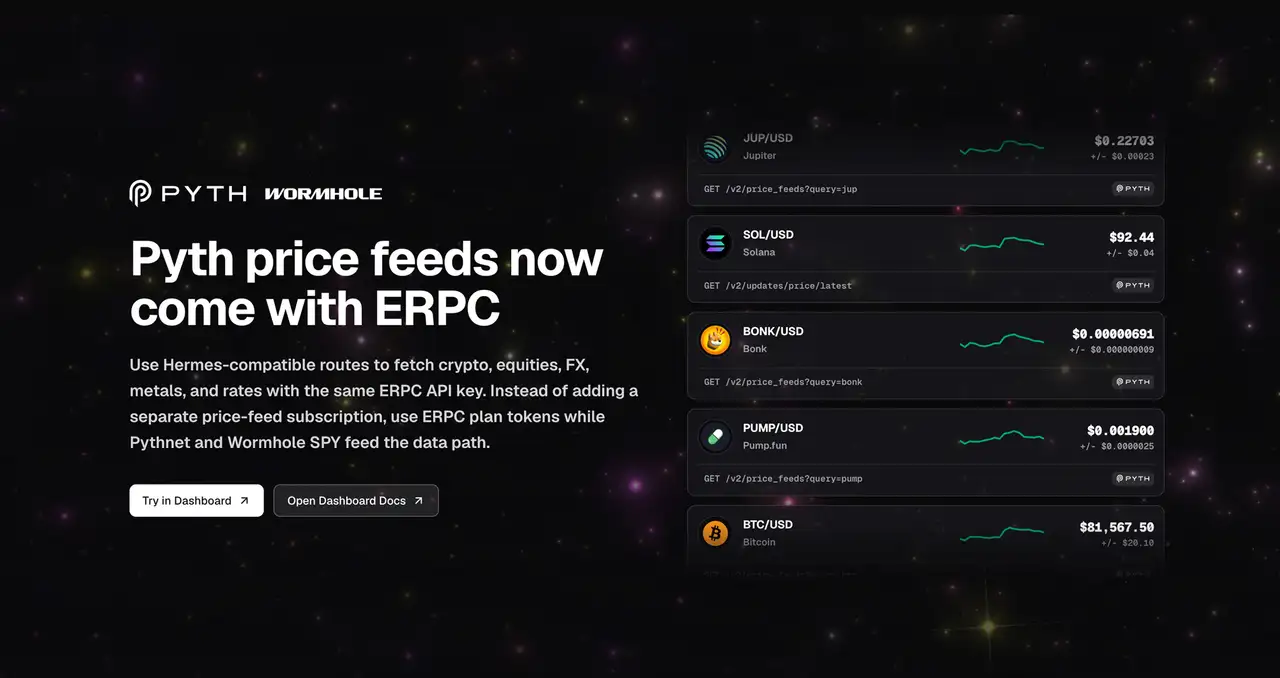
The core of this update is the integration of a market price data API into Solana RPC. ERPC has continued to improve Solana RPC not as a simple JSON-RPC endpoint, but as a Solana-specialized platform that supports the data retrieval, real-time subscriptions, historical lookups, transaction verification, network connectivity, and server infrastructure required by production Solana applications.
The Price API extends this direction further. In Solana applications, on-chain data alone is often not enough to satisfy real product requirements. Trading screens need price displays. Wallets need asset valuation. DeFi applications need prices for collateral valuation, liquidation conditions, and risk checks. Analytics infrastructure needs to connect on-chain events with market prices. AI agents and bots need to handle both on-chain state and external market conditions at the same time.
With ERPC Price API, developers can begin validating market price data retrieval at the same time as they integrate Solana RPC. Before searching for another market data provider, creating another API key, understanding another billing model, reading another set of documentation, and operating another monitoring flow, developers can test the Pyth-compatible Price API through the same flow as ERPC Solana RPC.
Pyth Hermes-Compatible Price API
ERPC Price API provides price feed search and latest price retrieval in a format compatible with Pyth Hermes. Pyth Hermes is a system that makes Pyth price updates available through REST APIs and server-side streaming, delivering price updates from Pythnet and the Wormhole Network as a Web API that is easier for developers to use.
Pythnet is a network for aggregating prices submitted by Pyth data providers. The Wormhole Network serves as a message transmission path that enables price updates generated on Pythnet to be used from other chains and application environments. Hermes continuously retrieves these price updates from Pythnet and the Wormhole Network and provides them in a format that applications can consume more easily.
ERPC operates a data retrieval and observation path that combines a Pythnet node, Hermes client, and Wormhole Spy. Wormhole Spy is a daemon for observing message traffic on the Wormhole Guardian Network, making it easier for applications to observe updates on the Wormhole Network. Through this architecture, ERPC makes price data derived from Pyth easier to access within the ERPC Solana RPC platform.
3,059+ Price Feeds and Broad Asset Class Coverage
Pyth is a market price data network covering a broad range of asset classes, including crypto, equities, FX, metals, rates, commodities, and futures. The official Pyth website lists 3,059+ Price Feeds and indicates access to global symbols across crypto, equities, futures, commodities, rates, and other categories.
With ERPC Price API support, developers can search for Pyth-compatible price feeds, identify the feeds they need, and retrieve the latest price updates through the Solana RPC usage flow. Beyond retrieving crypto prices for token valuation and trading decisions on Solana, developers can combine FX, equities, metals, rates, and commodities data to build broader financial applications and analytics systems.
When handling price data, market hours for each asset class are also important. Crypto assets trade 24/7, while equities, metals, rates, commodities, and FX each have different market hours, holidays, and maintenance windows. ERPC Price API provides access to price data, while applications should still account for price, confidence, expo, publish time, market hours for the target asset class, and staleness thresholds in their own design.
Price API Available Directly from the Dashboard
In the ERPC Dashboard, developers can manage Solana RPC usage and plans while also testing Price API requests through the documentation flow. Key retrieval methods compatible with Pyth Hermes, such as price feed search and latest price retrieval, can be checked from the same development flow as ERPC Solana RPC.
This allows developers to validate price retrieval with the same API key and ERPC Tokens while checking their Solana RPC endpoint. It also makes it easier to start building implementations that combine on-chain data and market price data in wallets, trading applications, DeFi products, analytics infrastructure, monitoring systems, AI agents, bots, and other Solana applications.
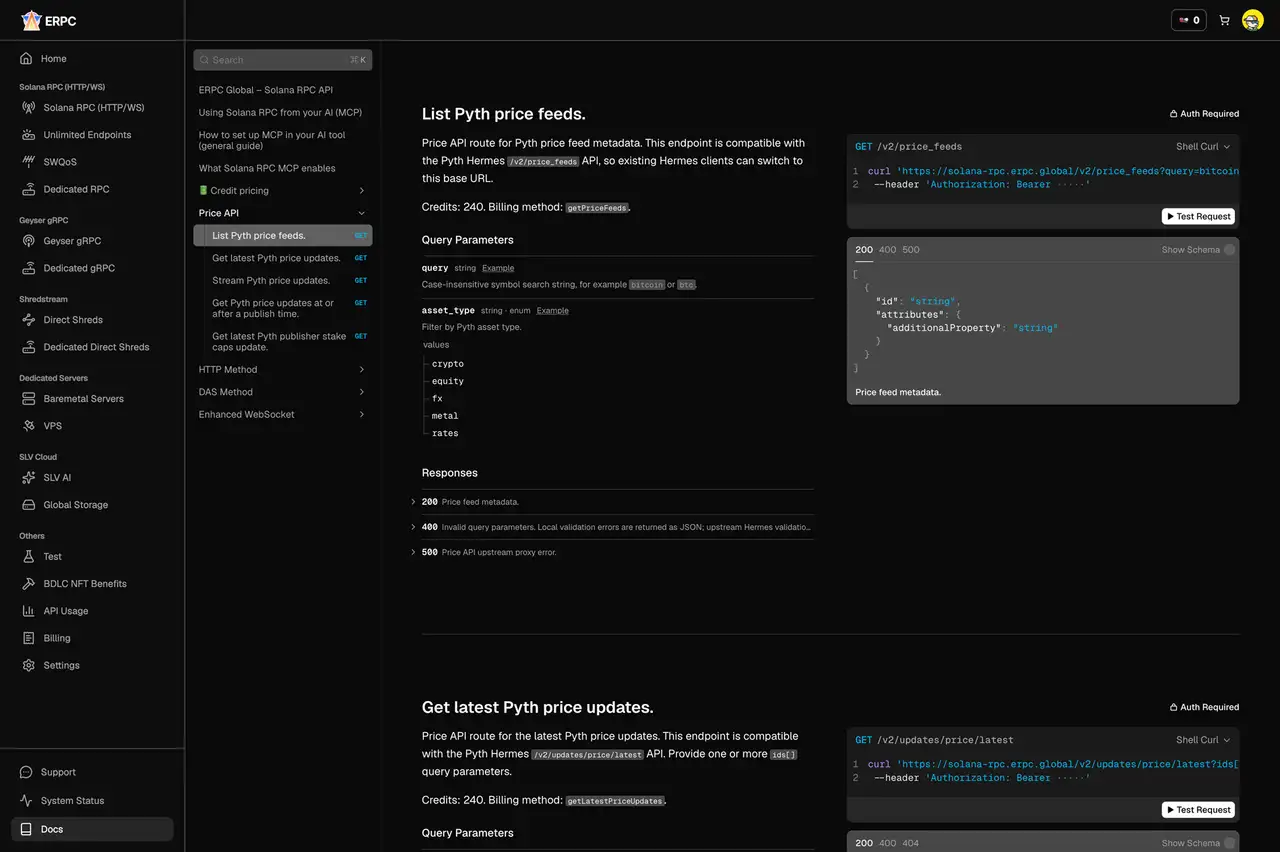
Use Cases for Solana Applications
ERPC Price API can be used across a wide range of Solana application scenarios.
Wallets and portfolio management tools can combine holdings such as tokens, NFT-related assets, DeFi positions, and deposit or withdrawal history with price data to display asset valuations. Explorers and analytics dashboards can show on-chain events not only as token amounts, but also with financial context based on market prices.
In DeFi and trading applications, price data is connected to risk management, collateral valuation, liquidation conditions, trading decisions, alerts, and bot logic. By handling not only crypto prices but also FX, metals, equities, rates, and commodities data, Solana applications can reference a broader range of markets.
Price data is also important for AI agents and automated operation systems. By retrieving on-chain state from Solana RPC and market prices from Price API, AI agents can generate reports, monitor conditions, send notifications, perform checks, and support development and operations based on both on-chain and market data.
Using Solana RPC, DAS, WebSocket, and Price API Through the Same Flow
ERPC provides Solana RPC, WebSocket, DAS, Geyser gRPC, Shredstream, VPS, and bare metal servers as Solana-specialized infrastructure. With the addition of Price API, the range of data retrieval available to Solana applications has expanded further.
Solana applications combine more than just real-time subscriptions. They also require historical retrieval, asset information, transaction details, price data, and connections to external markets. ERPC treats these not as fragmented APIs, but as data paths that Solana applications actually need, making them available through the same dashboard, the same API key, the same ERPC Tokens, and the same operational flow.
Developers can try Price API through the same flow as ERPC Solana RPC, search for the feeds they need, retrieve latest prices, and integrate them into existing Solana RPC implementations. Existing ERPC users can begin validating Price API through their current ERPC flow before adding a separate market data service.
Price, Confidence, and Publish Time Matter When Handling Price Data
When integrating price data into an application, it is important to consider not only the price value itself, but also confidence, expo, publish time, and market hours for the target asset.
Pyth price updates include a confidence interval in addition to the price itself. Confidence can vary depending on market liquidity, volatility, trading hours, and data conditions, so applications using price data for trading, liquidation, collateral valuation, alerts, and similar purposes need to define their own acceptable thresholds.
publish time is also important for determining when a price was updated. Assets such as crypto trade 24/7, while equities, metals, rates, and commodities have market hours and holidays. ERPC Price API provides access to price data, while final risk rules, recency thresholds, fallback behavior, and alert conditions should be designed according to each application’s requirements.
Expanding the Data Retrieval Scope of Solana-Specialized Infrastructure
ERPC improves Solana RPC not as a simple API endpoint, but as infrastructure that supports the execution quality of Solana applications. In Solana, HTTP RPC, WebSocket, Geyser gRPC, Shredstream, SWQoS, server placement, validator quality, network paths, and processing node performance directly affect application speed and stability.
The addition of Price API expands the range of data retrieval required by Solana applications. By making on-chain state, real-time events, historical transactions, DAS, and price data available through the same development flow, ERPC helps developers reduce the initial burden of combining multiple infrastructure services and focus more directly on application design and validation.
ELSOUL LABO has been approved for the Dutch government’s WBSO research and development support program for five consecutive years since 2022. The company continues research and development in Solana RPC infrastructure, validator operations, real-time data distribution, and AI agent-based operations and development support, with those results reflected across ERPC, SLV, SLV AI, and the AS200261 Solana-specialized data center.
With ERPC Price API support, developers using Solana RPC can handle on-chain data and market price data through the same flow more easily. By combining real-time data, historical retrieval, asset information, and price data on the same platform, developers can move forward with the development and operation of wallets, trading applications, DeFi products, analytics infrastructure, monitoring systems, AI agents, and other Solana applications.
ERPC Dashboard: https://dashboard.erpc.global/en
ERPC Official Website: https://erpc.global/en
News